
“Any sufficiently advanced technology is equivalent to magic.” — Arthur C. Clarke
If you look at digital advertising today, it almost feels like that magic is already happening. Ads seem to know what we want. Products appear in our feeds at just the right time. Brands can predict behavior with surprising accuracy. But what feels magical is actually the result of rapid technological evolution.
Over the next five years, three developments will have the most significant impact on digital advertising: AI-driven optimization, the shift to privacy-first data strategies, and the rise of immersive advertising through augmented reality.

1. AI-Driven Advertising Will Transform Performance and Profitability
Artificial intelligence is no longer just a tool for automation. It is becoming the engine behind digital advertising strategy. Reuters (2025), reporting on projections from PwC, one of the world’s largest professional services firms, notes that AI-powered advertising is expected to drive major growth in the global entertainment and media industry. That projection signals that AI is not just a passing trend. It is a structural shift.
The benefit here goes far beyond efficiency. AI enhances digital advertising by:
- Improving targeting precision through predictive modeling
- Optimizing media spend in real time
- Automatically testing and refining creative variations
- Increasing measurable return on investment
Instead of relying on broad audience segments, advertisers can now analyze behavioral signals, contextual data, and engagement patterns instantly. Campaigns become adaptive rather than static. Over the next five years, AI will extend digital advertising by making it more performance-driven, more accountable, and more scalable. What once required large teams and manual optimization can now happen continuously and intelligently.
In other words, the “magic” becomes more measurable.

2. Privacy-First Marketing Will Strengthen Trust and Long-Term Value
At the same time, the industry is undergoing a major reset around consumer privacy. Google’s shift away from third-party cookies has forced marketers to rethink data collection and targeting models (Usercentrics, n.d.). This change is often framed as a limitation, but it may actually strengthen digital advertising in the long term.
As third-party tracking declines, brands must rely more heavily on first-party data collected directly from customers through loyalty programs, apps, subscriptions, and direct interactions. According to Usercentrics (n.d.), marketers must adapt to evolving consent requirements and new privacy standards.
The benefit of this shift is strategic. First-party data is typically more accurate, more relevant, and based on an existing relationship. When consumers willingly share data in exchange for value, advertising becomes less intrusive and more intentional. Over the next five years, digital advertising will extend beyond targeting and move toward relationship building. Brands that prioritize transparency and consent will not only comply with regulations but also build stronger brand equity and customer lifetime value.
The magic here is trust.
3. Immersive Advertising Will Redefine Engagement
The third major development is the rise of immersive advertising formats, particularly augmented reality. Research published in ACR Journal suggests that augmented reality advertising significantly influences consumer perceptions and engagement compared to traditional formats (Rashmi et al., n.d.).
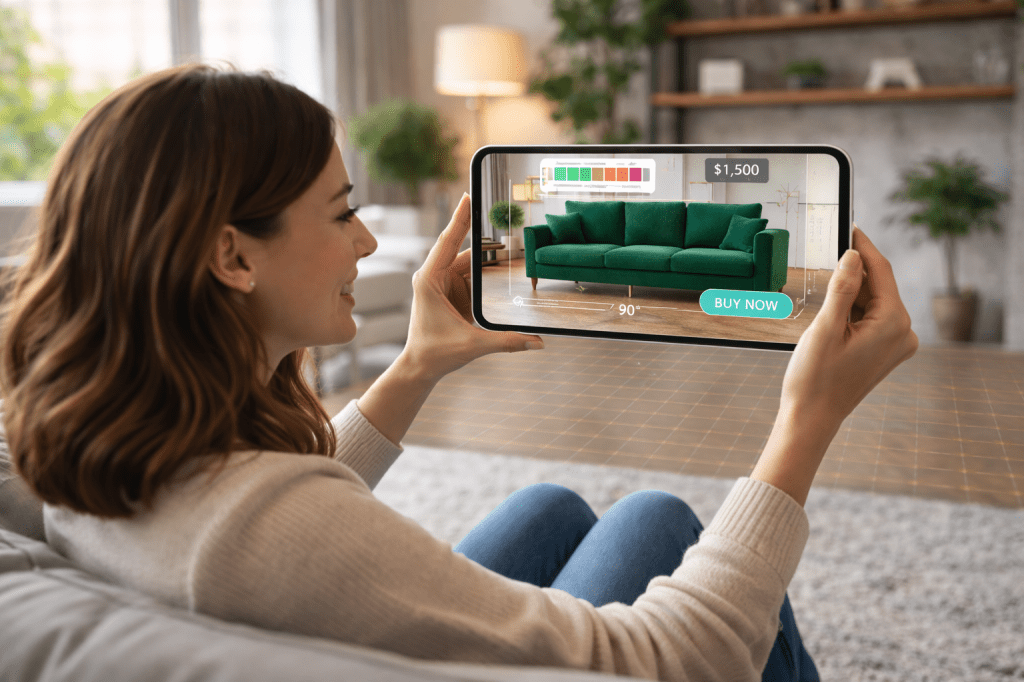
This matters because attention is the most limited resource in digital environments. Immersive experiences transform advertising from something consumers watch into something they participate in. For example, AR allows users to visualize furniture in their homes, try on products virtually, or explore features interactively.
The benefit is not just novelty. Immersive advertising:
- Increases time spent interacting with the brand
- Enhances memory retention
- Reduces purchase uncertainty
- Shortens the path from awareness to action
Over the next five years, immersive technology will extend digital advertising by blending storytelling, functionality, and commerce into a seamless experience. Instead of interrupting consumers, brands will invite them into interactive environments.
That is where technology begins to feel like magic again.
Conclusion
Digital advertising is entering a period where technology is not just improving efficiency. It is redefining how brands connect, build trust, and create experiences. AI will make campaigns smarter and more profitable. Privacy-first strategies will strengthen relationships and long-term value. Immersive technologies will transform engagement from passive viewing to active participation.
If Clarke was right, and sufficiently advanced technology feels like magic, then the next five years of digital advertising may be the most magical yet.
References
OpenAI. (2026). AI-generated marketing concept images [Digital images]. ChatGPT.
PwC says AI-powered ads drive growth in global entertainment and media industry. (2025, July 24). Reuters. https://www.reuters.com/business/media-telecom/ai-powered-ads-drive-growth-global-entertainment-media-industry-pwc-says-2025-07-24/
Rashmi, C. P., Jain, L., Saroj, N., Bhavsar, R., & K. P., Z. (n.d.). The impact of augmented reality (AR) on television advertising: A consumer perspective. ACR Journal. https://acr-journal.com/article/the-impact-of-augmented-reality-ar-on-television-advertising-a-consumer-perspective/
Usercentrics. (n.d.). Google third-party cookies: What marketers need to know. https://usercentrics.com/knowledge-hub/google-third-party-cookies/






 Marketing Adventure