
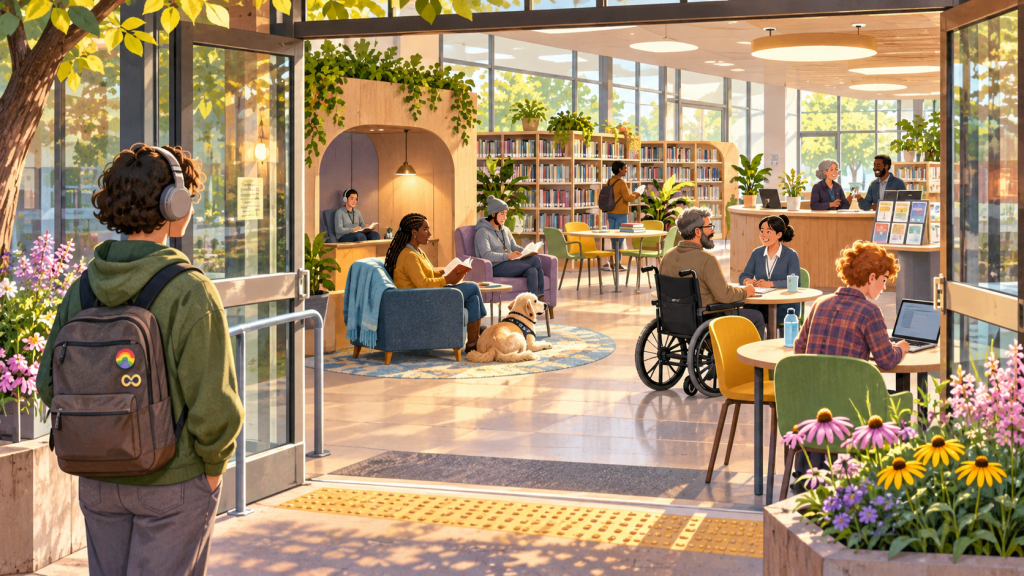
Understanding behavior, challenging assumptions, and creating communities where everyone belongs.
One of the things working in a public library has taught me is that we rarely know the full story of the people we encounter. We see their behavior, hear their words, and sometimes make assumptions without realizing we’re doing it. I’ve been thinking about how easily those assumptions can shape our responses, particularly when someone experiences the world differently than we do.
We all interpret the world through the lens of our own experiences. Sometimes that helps us understand others, but sometimes it limits what we’re able to see.
Consider someone pacing, talking quietly to themselves, or making repetitive movements. We might assume they are experiencing a mental health crisis, struggling with substance use, or simply behaving unusually. But there may be explanations we haven’t considered.
One possibility that deserves more attention is autism, particularly among people experiencing homelessness.
The more I learn about the relationship between autism and homelessness, the more I realize how important it is to question our assumptions. Not because every unusual behavior has an explanation we can identify, but because we don’t always need to understand someone’s circumstances to respond with compassion.
And sometimes, those assumptions can create additional barriers for people who are already struggling.
A Connection We Don’t Talk About Enough
Autism is a lifelong neurodevelopmental difference that can influence communication, sensory processing, social interaction, and how someone experiences the world.
According to the Centers for Disease Control and Prevention (2025), approximately 1 in 31 eight-year-old children across 16 monitored U.S. communities had been identified with autism in 2022.
But what about autistic adults, particularly those who grew up before autism was widely recognized or who never had access to an evaluation?
And what happens when those adults experience housing instability?
A 2019 study published in Autism examined 106 people receiving services from a homelessness outreach team in the United Kingdom. Researchers found that 12.3% screened positive for characteristics consistent with autism, while another 8.5% displayed some autistic traits without meeting the study’s full screening threshold (Churchard et al., 2019).
These findings are important, but they come with limitations. The study was relatively small, and screening positive does not establish a formal autism diagnosis. We cannot assume these percentages represent everyone experiencing homelessness.
What the research does suggest, however, is that autistic people may be overlooked within homeless populations, and that existing services may not always recognize or accommodate their needs.
That raises an important question.
How many people are struggling not simply because they lack support, but because the support available to them was never designed with their needs in mind?
When Everyday Systems Become Barriers
Think about everything required to maintain housing.
Finding employment. Navigating interviews. Managing finances. Communicating with landlords. Completing applications. Keeping track of appointments, deadlines, and paperwork.
These tasks can be stressful for anyone.
For some autistic adults, additional challenges involving sensory processing, executive functioning, communication differences, or unexpected changes can make navigating these systems especially difficult.
Now imagine trying to manage all of that without reliable transportation, a stable address, adequate income, or someone to help you understand the process.
Research exploring the lived experiences of autistic people who have experienced homelessness identifies barriers involving relationships, support systems, and access to suitable accommodations (Stone et al., 2023).
It is important to recognize that autism itself does not inevitably lead to homelessness. Autistic people have diverse abilities, experiences, and support needs.
The problem often lies in the mismatch between individual needs and systems built around a narrow definition of how people are expected to communicate, work, and function.
We frequently talk about helping people become more independent.
But I wonder whether we spend enough time asking if the systems they must navigate are unnecessarily complicated.
When a Shelter Doesn’t Feel Safe
Imagine finally finding a place to sleep after spending the day worrying about where you will go.
Now imagine that place is crowded, brightly lit, noisy, and unpredictable.
People are moving around. Conversations overlap. Doors open and close. You have little privacy or control over your surroundings.
For someone with significant sensory sensitivities, that environment may be overwhelming.
Autistic people can experience sensory input differently. Sounds, lighting, touch, and crowded environments that others barely notice may cause substantial distress.
Research into autism and homelessness has identified the suitability of shared accommodations, sensory needs, and difficulties navigating change as potential barriers to housing stability and accessing services.
This does not mean every autistic person finds shelters intolerable or that sensory issues explain why someone remains outdoors. People avoid or leave shelters for many reasons, including safety concerns, restrictions, previous experiences, and lack of suitable accommodations.
But sensory accessibility deserves a place in that conversation.
Providing a service is not the same thing as making that service accessible.
That distinction matters.
What We See Isn’t Always What We Think
One of the things I find most important about this research is how it challenges our interpretations of behavior.
Consider someone rocking gently, pacing, repeating words, or speaking aloud while completing a task.
For some autistic people, repetitive movements or sounds are forms of stimming, or self-regulation. These behaviors may help someone manage stress, concentrate, express emotion, or process sensory information.
Others may need additional time to respond to questions, communicate more comfortably through writing, or struggle when several people speak to them at once.
But here is where we need to be careful.
None of these behaviors, on their own, tells us that someone is autistic. They can occur for many different reasons, including disability, stress, illness, substance use, or simply personal habit.
We cannot diagnose someone by watching them from across a room.
What we can do is recognize that our first interpretation may not be the correct one.
And that realization should influence how we respond.
Instead of immediately asking, “What is wrong with this person?” perhaps we should begin asking, “Is there something about this situation that is making things more difficult for them?”
It is a small change in perspective, but I believe it can make an enormous difference.
The Role of Public Libraries
Working in a public library has made me especially interested in how public spaces serve people with very different needs.
Libraries are among the few places where someone can spend time indoors without being expected to purchase something.
They offer access to information, technology, community resources, and human connection.
For someone experiencing homelessness, a library may also provide a place to rest, charge a phone, complete an application, or simply exist without the constant pressure of being moved along.
That makes libraries especially important.
It also means library staff encounter people whose experiences and needs may be very different from their own.
A patron might pace while thinking. Someone may speak aloud while using a computer. Another person might become overwhelmed when asked several questions in quick succession.
Our responsibility is not to determine whether those behaviors are associated with autism, mental illness, or something else.
Our responsibility is to treat people respectfully, maintain a safe environment, and respond to actual behavior rather than assumptions about what that behavior means.
Sometimes that means speaking more clearly. Sometimes it means giving someone additional time to respond. Sometimes it means offering written instructions or finding a quieter place to have a conversation.
And sometimes it means recognizing that behavior we personally find unusual is not necessarily harmful or disruptive.
Of course, libraries must maintain reasonable expectations for everyone. Accessibility does not mean ignoring safety concerns or allowing conduct that harms others.
It means considering whether we can meet those expectations in ways that do not create unnecessary barriers.
I think this principle extends well beyond libraries.
It applies to shelters, hospitals, government offices, workplaces, and nearly every other place where people interact with public services.
Understanding Should Come Before Judgment
I keep coming back to the idea that understanding should precede judgment.
We live in a society that places tremendous value on independence, productivity, and the ability to navigate complicated systems.
Yet we do not all begin with the same resources, abilities, or opportunities.
For someone who is autistic and experiencing homelessness, the challenges may extend far beyond finding an affordable place to live.
They may also involve finding employment that accommodates their needs, accessing services that communicate effectively, and locating housing where they can feel physically and emotionally safe.
None of these issues can be solved by patience alone.
We need affordable housing, accessible services, better-informed professionals, and policies that recognize the diversity of human needs.
But patience and understanding are still part of the solution.
We can make fewer assumptions. We can listen more carefully. We can question whether the rules and routines we take for granted unintentionally exclude others.
And perhaps most importantly, we can remember that someone should not have to explain their disability, disclose a diagnosis, or prove that their struggles are legitimate before being treated with dignity.
A Community That Makes Room for Everyone
I believe the strength of a community is reflected not only in the resources it provides, but in how accessible those resources are to the people who need them most.
It is easy to say that everyone deserves support.
It is harder to examine whether the support we offer truly works for everyone.
The connection between autism and homelessness reminds us that people can fall through the cracks for reasons we may never recognize unless we are willing to look beyond our assumptions.
We will not always understand another person’s behavior or circumstances.
But we can choose curiosity over judgment, compassion over suspicion, and understanding over assumptions.
And maybe that is where meaningful change begins.
Not with expecting everyone to navigate the world in the same way, but with creating a world that makes room for the many different ways people experience it.
References and Further Reading
Centers for Disease Control and Prevention. (2025). Data and statistics on autism spectrum disorder. https://www.cdc.gov/autism/data-research/index.html
Churchard, A., Ryder, M., Greenhill, A., & Mandy, W. (2019). The prevalence of autistic traits in a homeless population. Autism, 23(3), 665–676. https://doi.org/10.1177/1362361318768484
Cordis Bright. (2025). Neurodiversity and homelessness: Understanding the overlap. https://www.cordisbright.co.uk/news/neurodiversity-and-homelessness-understanding-the-overlap
Stone, B., Cameron, A., & Dowling, S. (2023). The autistic experience of homelessness: Implications from a narrative enquiry. Autism, 27(2), 489–499. https://doi.org/10.1177/13623613221105091


Leave a Reply